


As a supplier of NPN transistors, I understand the critical importance of heat dissipation in these electronic components. NPN transistors are widely used in various electronic circuits, from simple switching applications to complex amplifier circuits. However, during operation, they generate heat, and if not properly managed, this heat can lead to performance degradation, reduced lifespan, and even permanent damage. In this blog, I will share some effective methods to dissipate heat from an NPN transistor.
Understanding the Heat Generation Mechanism in NPN Transistors
Before diving into the heat dissipation methods, it's essential to understand how heat is generated in an NPN transistor. An NPN transistor consists of three layers of semiconductor material: the emitter, base, and collector. When a current flows through the transistor, there is a voltage drop across the junctions (emitter - base and collector - base). According to the power formula (P = VI) (where (P) is power, (V) is voltage, and (I) is current), power is dissipated in the form of heat at these junctions.
The power dissipation (P_D) in an NPN transistor can be calculated using the formula (P_D=V_{CE}I_C + V_{BE}I_B), where (V_{CE}) is the collector - emitter voltage, (I_C) is the collector current, (V_{BE}) is the base - emitter voltage, and (I_B) is the base current. In most cases, the power dissipated at the collector - emitter junction ((V_{CE}I_C)) is the dominant factor.
Heat Dissipation Methods
1. Heat Sinks
Heat sinks are one of the most common and effective ways to dissipate heat from an NPN transistor. A heat sink is a passive device that increases the surface area of the transistor, allowing more heat to be transferred to the surrounding air. Heat sinks are typically made of materials with high thermal conductivity, such as aluminum or copper.
When selecting a heat sink for an NPN transistor, several factors need to be considered. First, the thermal resistance of the heat sink is crucial. Thermal resistance ((R_{th})) is a measure of how well a material or device resists the flow of heat. A lower thermal resistance means better heat transfer. The power dissipation of the transistor and the ambient temperature also play a role in heat sink selection. For example, if a transistor dissipates a large amount of power, a larger and more efficient heat sink may be required.

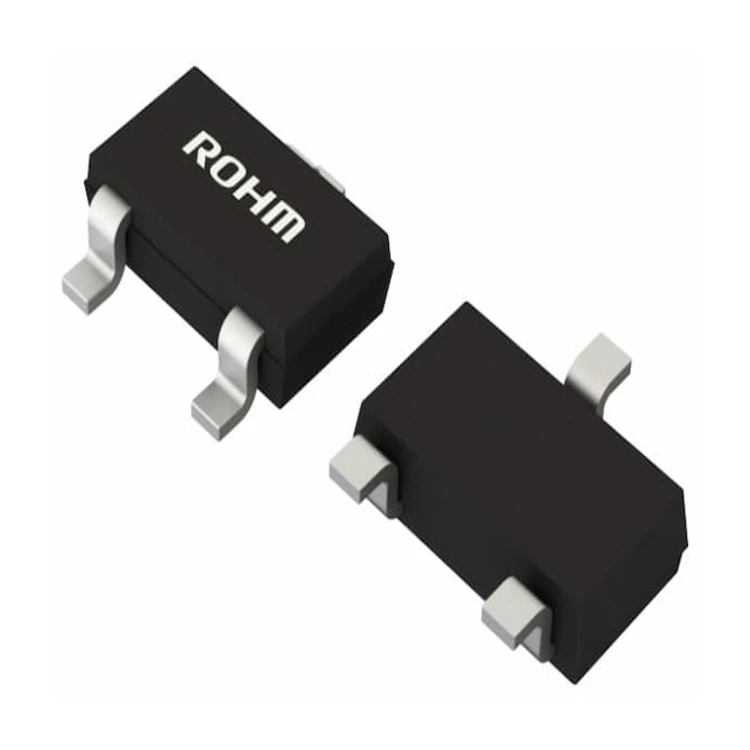
To attach a heat sink to an NPN transistor, thermal grease or thermal tape can be used. Thermal grease fills in the microscopic gaps between the transistor and the heat sink, improving thermal contact and reducing thermal resistance. Thermal tape, on the other hand, provides a convenient way to attach the heat sink without the need for additional hardware.
2. Forced Air Cooling
In some applications where the heat generated by the NPN transistor is too high to be dissipated by natural convection alone, forced air cooling can be employed. Forced air cooling involves using a fan to blow air over the transistor or the heat sink, increasing the rate of heat transfer.
The effectiveness of forced air cooling depends on several factors, including the airflow rate, the direction of the airflow, and the design of the heat sink. A higher airflow rate generally results in better heat dissipation. The direction of the airflow should be optimized to ensure that the air passes over the entire surface of the heat sink. Additionally, the design of the heat sink can be optimized for forced air cooling, such as using fins with a shape that promotes better airflow.
However, forced air cooling also has some drawbacks. Fans consume power, generate noise, and require regular maintenance. Therefore, it should be used only when necessary.
3. Liquid Cooling
For high - power applications, liquid cooling can be a more efficient solution for heat dissipation from NPN transistors. Liquid cooling systems use a liquid, such as water or a coolant, to absorb and transfer heat away from the transistor.
A typical liquid cooling system consists of a cold plate, a pump, a radiator, and a fan. The cold plate is attached to the transistor, and the liquid circulates through the cold plate, absorbing heat from the transistor. The heated liquid is then pumped to the radiator, where it releases the heat to the surrounding air with the help of a fan.
Liquid cooling offers several advantages over air cooling. It has a higher heat transfer coefficient, which means it can dissipate heat more effectively. It also allows for more compact designs, as the liquid can be routed through small channels. However, liquid cooling systems are more complex and expensive to implement, and they require careful maintenance to prevent leaks.
4. Circuit Design Optimization
In addition to using external heat dissipation methods, optimizing the circuit design can also help reduce the heat generated by an NPN transistor. One way is to operate the transistor in the appropriate mode. For example, in switching applications, the transistor should be switched between the fully - on and fully - off states as quickly as possible to minimize the time it spends in the active region, where power dissipation is high.
Another approach is to use a transistor with lower power consumption. Our company offers a range of Low Power Consumption NPN Transistors that are designed to minimize power dissipation and reduce heat generation. These transistors are suitable for battery - powered devices and other applications where power efficiency is crucial.
Importance of Proper Heat Dissipation
Proper heat dissipation is essential for the reliable operation of NPN transistors. Excessive heat can cause the transistor's performance to degrade. For example, the gain of the transistor may decrease, and the operating frequency may be limited. High temperatures can also accelerate the aging process of the transistor, reducing its lifespan.
In extreme cases, overheating can lead to thermal runaway. Thermal runaway occurs when the power dissipation of the transistor increases with temperature, causing a positive feedback loop that can quickly lead to the destruction of the transistor.
Selecting the Right NPN Transistor for Your Application
When selecting an NPN transistor for your application, it's important to consider its power dissipation capabilities and heat dissipation requirements. Our company offers a wide range of NPN transistors, including High - speed Switching NPN Transistors that are suitable for high - frequency applications.
We also provide technical support to help you select the right transistor and design an effective heat dissipation solution. Our team of experts can assist you in calculating the power dissipation of your circuit, selecting the appropriate heat sink or cooling system, and optimizing your circuit design for heat management.
Conclusion
Heat dissipation is a critical aspect of using NPN transistors in electronic circuits. By understanding the heat generation mechanism and using appropriate heat dissipation methods, such as heat sinks, forced air cooling, liquid cooling, and circuit design optimization, you can ensure the reliable operation and long lifespan of your NPN transistors.
If you are interested in purchasing NPN transistors or need further advice on heat dissipation, please feel free to contact us for procurement discussions. We are committed to providing high - quality products and professional services to meet your needs.
References
- Boylestad, R. L., & Nashelsky, L. (2012). Electronic Devices and Circuit Theory. Pearson.
- Sedra, A. S., & Smith, K. C. (2015). Microelectronic Circuits. Oxford University Press.


